5 Questions Every Property Manager Should Ask Their Tenant Screening Provider
 Lauren Walton·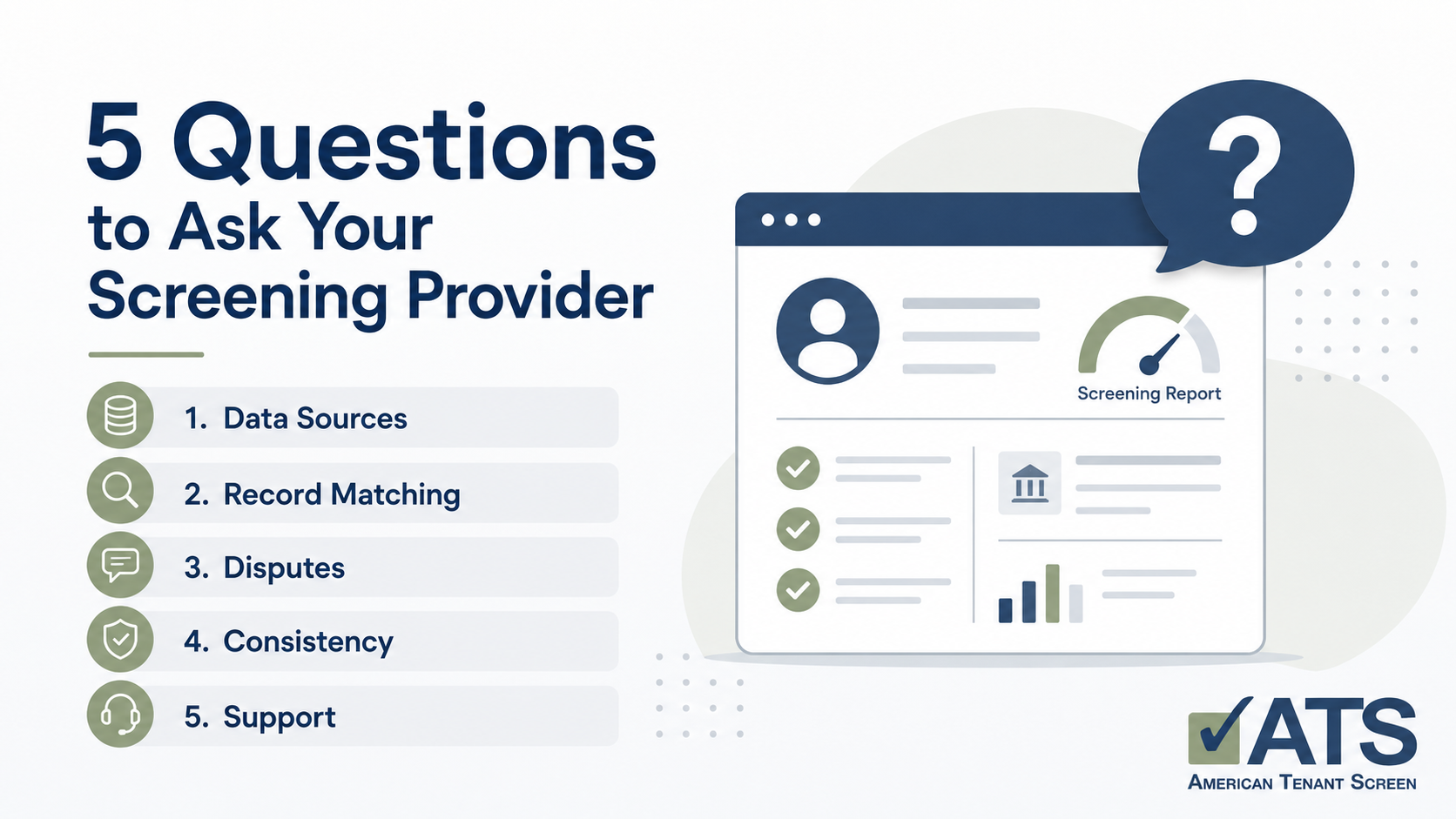
Choosing a tenant screening provider can sometimes feel like comparing identical services.
Most providers offer some combination of credit reports, criminal background checks, eviction searches, identity verification, and other applicant information.
At first glance, the differences may seem minor.
But behind those reports are important questions about data quality, accuracy, compliance procedures, record matching, customer support, and how information is actually collected.
Those differences can have a significant impact on your screening process.
Whether you are evaluating a new provider or reviewing your current relationship, here are five questions every property manager should ask.
1. Where Does Your Information Come From?
This should be one of the first questions you ask.
Not all tenant screening data comes from the same sources.
A provider may use a combination of:
- Credit bureaus
- County court records
- State repositories
- Federal court records
- Public-record databases
- Eviction-related court records
- Identity databases
- Other third-party information sources
Understanding where information comes from helps you understand the scope and limitations of the report.
For example, a broad database search may be useful for identifying possible records, but it may not provide the same information as researching an original court source.
Ask your provider to explain what is being searched rather than simply accepting terms such as “nationwide” or “national database.”
A useful follow-up question:
If a possible record is found, what steps are taken to determine whether it actually belongs to my applicant?
That leads to the second question.
2. How Do You Make Sure a Record Belongs to the Right Person?
A criminal record or eviction case is only useful if it belongs to the applicant being screened.
Matching records can be complicated.
Many people share similar or identical names. Addresses change. Dates of birth can be entered incorrectly. Public records can contain incomplete identifying information.
A responsible screening process should have procedures designed to reduce the risk of mismatching records.
Ask your screening provider how it handles:
- Common names
- Middle names and initials
- Previous addresses
- Date-of-birth information
- Incomplete identifiers
- Possible duplicate records
The goal is not simply to return as many records as possible.
The goal is to provide accurate information associated with the correct individual.
More results do not necessarily mean a better screening report.
In some situations, a provider that returns fewer but better-verified records may provide more useful information than one that produces a long list of possible matches.
3. What Happens When an Applicant Disputes Information?
Even strong screening systems can encounter disputes.
Applicants may believe information on a report is inaccurate, incomplete, outdated, or belongs to someone else.
When that happens, your screening provider should have an established process.
Ask questions such as:
- How does an applicant submit a dispute?
- Who investigates the disputed information?
- How is the housing provider notified?
- What documentation may be required?
- How are corrected reports handled?
- How can applicants contact your consumer-relations team?
You do not want to discover the answers to these questions for the first time when an upset applicant calls your leasing office.
A well-defined dispute process is an important part of the screening relationship.
It can also make life easier for your property management team by giving staff a clear procedure to follow.
4. How Do You Help Clients Stay Consistent With Their Screening Process?
A screening provider cannot make your housing policies for you.
However, a good provider should understand the environment in which tenant screening reports are used.
Ask what tools or resources are available to help your organization maintain a consistent process.
For example:
- Can screening packages be standardized across properties?
- Can reports be configured around established criteria?
- Are users trained on what information appears in the report?
- Are resources available explaining adverse action procedures?
- Can user access be limited based on job responsibilities?
- Are there tools that help your team follow the same workflow?
Consistency matters because rental decisions should not depend on which leasing agent happens to review the application that day.
The technology supporting your screening program should make consistency easier, not harder.
5. Who Can I Call When Something Doesn't Make Sense?
This question often gets overlooked.
Until something goes wrong.
Imagine your leasing manager receives a report containing an unfamiliar record.
The applicant disputes the information.
A court record is difficult to understand.
A report has not returned when expected.
Or your organization opens a new property in a state where your team has questions about available screening services.
Who helps?
Some providers offer little more than an online portal and a generic support inbox.
Others provide access to knowledgeable representatives who understand screening reports and can help clients navigate the process.
Ask:
- Is live support available?
- What are the support hours?
- Do we have a dedicated contact?
- Who helps explain report results?
- What happens when a search is delayed?
- How quickly are client questions typically addressed?
Screening technology is important.
But when your team has a question involving a real applicant and a real rental decision, knowledgeable support can be just as important.
A Few Bonus Questions Worth Asking
The five questions above are a strong starting point, but they are not the only questions worth discussing.
When evaluating a screening provider, you may also want to ask:
How Fast Are Reports Typically Completed?
Turnaround time matters, particularly in competitive rental markets.
But make sure you understand what “instant” really means.
Some records may be available electronically while other searches require additional research or verification.
The fastest result is not always the most complete or accurate result.
How Do You Protect Applicant Information?
Tenant screening involves sensitive personal information.
Ask about the provider's procedures for protecting applicant data, controlling access, authenticating users, and maintaining information security.
What Screening Options Are Available?
Your organization may need different services for different property types or screening policies.
Ask whether the provider offers options such as:
- Credit reports
- Criminal record searches
- Eviction history
- Identity verification
- Income verification
- Rental history verification
- Customized screening packages
Understanding your options can help you avoid paying for services you do not need while ensuring important searches are not being overlooked.
How Are We Notified When Regulations or Procedures Change?
Tenant screening operates within a complex legal environment.
Requirements may come from federal law as well as state and local regulations.
While a screening provider should not replace your legal counsel, it can still be valuable to know whether the provider shares relevant industry updates, educational resources, or changes affecting its services.
Price Shouldn't Be the Only Question
Price matters.
Every property management company has budgets and operational targets.
But tenant screening is one area where the cheapest report may not always represent the best value.
A low-cost screening service may become expensive if it creates:
- Additional staff work
- Poor applicant experiences
- Delays
- Inaccurate information
- Difficult-to-understand reports
- Limited support
- Inconsistent processes
Instead of asking only, “What does a report cost?”, consider asking:
“What are we getting for that cost?”
A reliable screening provider should help you understand exactly what services are being delivered.
Your Screening Provider Should Be a Resource
Tenant screening companies do more than supply data.
The strongest provider relationships help property managers understand the information they are receiving and use it as part of a well-defined screening process.
Your provider should be able to clearly explain:
- What it searches
- Where the information comes from
- How records are matched
- How disputes are handled
- What support is available
If the answers are vague, that may be worth exploring further.
The Bottom Line
Your tenant screening provider plays an important role in one of the most consequential parts of property management: deciding who qualifies to rent your properties.
That makes it worth looking beyond price and turnaround time.
Ask how the provider obtains its information.
Ask how records are matched.
Ask what happens when information is disputed.
Ask how the system supports consistent procedures.
And make sure you know who will answer the phone when your team needs help.
Key Takeaway
Before choosing—or renewing with—a tenant screening provider, ask one simple question:
“Are we buying a report, or are we choosing a screening partner?”
The best answer should be a little bit of both.
This article is provided for general informational purposes and is not intended as legal advice. Housing providers should develop screening policies in consultation with qualified legal counsel and comply with all applicable federal, state, and local requirements.
Lauren Walton
Director of Client Solutions
I have worked for ATS since 2010, and I am passionate about helping our clients utilize our services to their advantage to find the most qualified tenants and employees. I have a degree in Interior Design, and in my free time, I enjoy cooking, reading, visiting the beach, and spending time with my husband and our dog, Dixie.
Comments (0)
Be the first to comment.