Can You Spot a Fake Pay Stub? How AI Is Changing Rental Application Fraud
 Lauren Walton·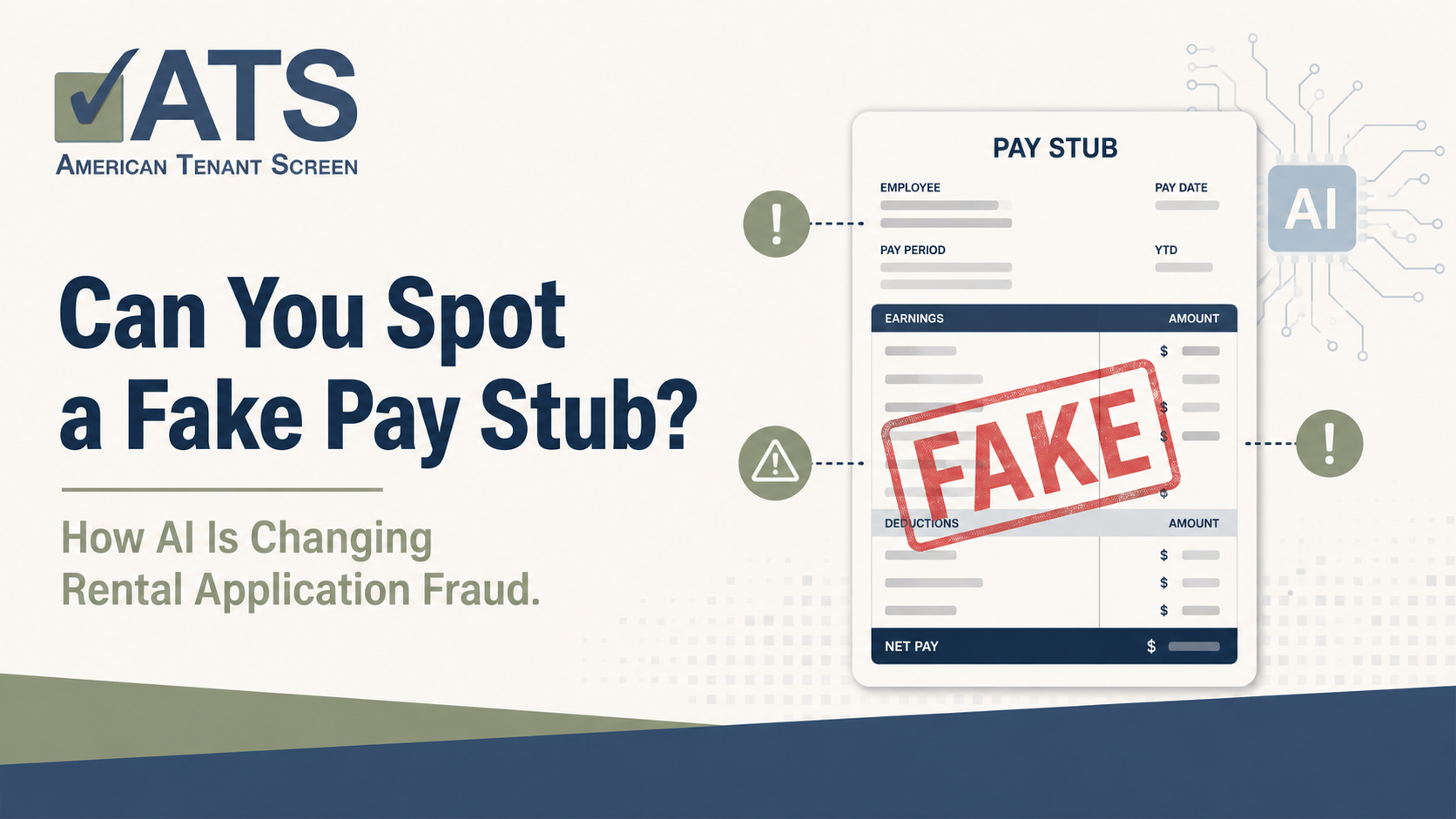
For years, verifying a rental applicant's income often involved a familiar process:
Ask for a few recent pay stubs.
Review the employer information.
Check the numbers.
Move on.
Today, that process may not be enough.
Digital editing tools have made financial documents easier to alter for some time. Now, artificial intelligence is adding another layer to the challenge by making it easier to generate professional-looking text, documents, logos, and supporting information.
For property managers, the question is becoming less about “Does this pay stub look real?” and more about “Can this income actually be verified?”
Why Fake Pay Stubs Are Becoming Harder to Identify
Older fraudulent documents often contained obvious mistakes.
A fake pay stub might have:
- Poor formatting
- Incorrect calculations
- Misspelled company names
- Mismatched fonts
- Obviously edited numbers
Those clues haven't disappeared.
But today's tools can help someone create documents that look far more polished.
Templates are readily available online. PDF editors can modify existing documents. Generative AI can produce realistic company descriptions, employment letters, email language, and other supporting material.
The result?
A document can look completely legitimate at first glance and still contain inaccurate information.
What Can Be Faked?
Income fraud isn't limited to changing one number on a pay stub.
Depending on the situation, someone attempting to misrepresent their finances could potentially provide altered or fabricated:
- Pay stubs
- Bank statements
- Employment verification letters
- Offer letters
- Tax documents
- Business records
- Employer contact information
- Reference information
A convincing application may even contain several pieces of supporting documentation that appear to reinforce one another.
That is why visual inspection alone has limitations.
Red Flags Property Managers Can Look For
There is no single sign that proves a pay stub is fraudulent.
However, certain inconsistencies may justify additional verification.
1. The Math Doesn't Add Up
One of the most useful checks is also one of the simplest.
Look at whether the numbers make sense.
For example:
Does gross pay match the employee's stated hourly rate and hours worked?
Do deductions appear reasonable relative to gross income?
Does year-to-date income align with the number of pay periods that have occurred?
Do consecutive pay stubs show logical changes?
Documents created or edited manually sometimes contain mathematical inconsistencies.
2. Formatting Changes Within the Document
Look for subtle differences such as:
- Different fonts
- Uneven spacing
- Numbers that don't line up
- Unusual decimal placement
- Blurry areas around certain figures
- Text that appears sharper or softer than surrounding text
These aren't definitive proof of manipulation, especially because legitimate payroll systems produce documents in many different formats.
They are simply reasons to consider additional verification.
3. The Employer Is Difficult to Verify
If an applicant reports working for an established company, the employer should generally have some independently verifiable presence.
Be cautious about relying exclusively on contact information supplied by the applicant.
For example, an applicant might provide:
John Smith — Supervisor
That may be legitimate.
But independently locating the organization and confirming its contact information can provide additional confidence.
4. The Pay Doesn't Match the Stated Employment
Consider whether the information is internally consistent.
If someone reports being paid every two weeks but provides three documents supposedly covering one month, something may be wrong.
Likewise, employment start dates, job titles, and salary information should generally align across the application and supporting documents.
The purpose isn't to determine whether someone's salary “sounds right.”
It's to identify contradictions between the applicant's own information.
AI Changes More Than the Document
One of the bigger challenges with AI-assisted fraud is that supporting information can potentially be generated as well.
For example, someone could use AI tools to help create:
- A professional employment verification letter
- A believable job description
- Email responses from a supposed employer
- A basic company website
- Business descriptions
- Supporting written documentation
That makes one lesson increasingly important:
A document should not necessarily verify itself.
Independent verification becomes more valuable when decisions depend heavily on the information contained in that document.
What Does Better Income Verification Look Like?
There isn't one verification method that works for every applicant.
People earn money in many different ways.
Some applicants have traditional W-2 employment.
Others may be:
- Self-employed
- Independent contractors
- Gig workers
- Commission-based employees
- Retired
- Receiving benefits
- Living from investment income
A good screening policy should account for legitimate variations while applying standards consistently.
Depending on your policies and applicable laws, verification may involve multiple sources of information rather than one uploaded document.
The important question is:
Can you reasonably verify the income information being used in your rental decision?
Don't Let Fraud Prevention Create Inconsistent Screening
When property managers become concerned about fraud, there can be a temptation to scrutinize certain applicants more heavily than others.
That creates another potential problem.
Screening procedures should be based on established, objective criteria.
For example, instead of deciding case by case whether an applicant “seems suspicious,” a housing provider might establish a written policy describing:
- What proof of income is required
- Which forms of income documentation are accepted
- When additional verification is necessary
- How self-employment income is evaluated
- How discrepancies are resolved
Consistency benefits everyone involved.
Property managers know what steps to follow.
Applicants know what documentation is expected.
And rental decisions are less dependent on subjective judgment.
The Applicant Experience Still Matters
Fraud prevention doesn't have to make the rental process unpleasant.
Most applicants are simply trying to find a place to live.
A transparent process can make verification easier for everyone.
Tell applicants upfront what documentation will be required and why.
Explain that verification procedures are standard.
Provide reasonable alternatives for people who don't receive traditional pay stubs.
And avoid requesting unnecessary documentation.
Good screening should reduce risk without creating unnecessary friction.
The Bigger Lesson: Verification Matters More Than Appearance
AI isn't necessarily creating an entirely new form of rental fraud.
Instead, it is making an old problem—misrepresenting information—potentially easier to execute and harder to identify visually.
That changes the value of traditional screening methods.
A pay stub may still be useful.
A bank statement may still be useful.
An employment letter may still be useful.
But relying solely on whether a document looks authentic is increasingly risky.
Modern tenant screening should focus on whether the information behind the document can be appropriately verified.
Key Takeaway
The question property managers should be asking is no longer simply:
“Does this pay stub look real?”
A better question is:
“Do I have a reliable and consistent way to verify the information it contains?”
As fraudulent documents become more sophisticated, verification, consistency, and reliable screening practices will become increasingly important parts of the rental application process.
This article is provided for general informational purposes and is not intended as legal advice. Tenant screening and income-verification requirements may vary by jurisdiction. Housing providers should consult qualified counsel regarding applicable federal, state, and local requirements.
Lauren Walton
Director of Client Solutions
I have worked for ATS since 2010, and I am passionate about helping our clients utilize our services to their advantage to find the most qualified tenants and employees. I have a degree in Interior Design, and in my free time, I enjoy cooking, reading, visiting the beach, and spending time with my husband and our dog, Dixie.
Comments (0)
Be the first to comment.