
Synthetic Identity Fraud: Is Your Rental Applicant Really Who They Say They Are?
 Lauren Walton·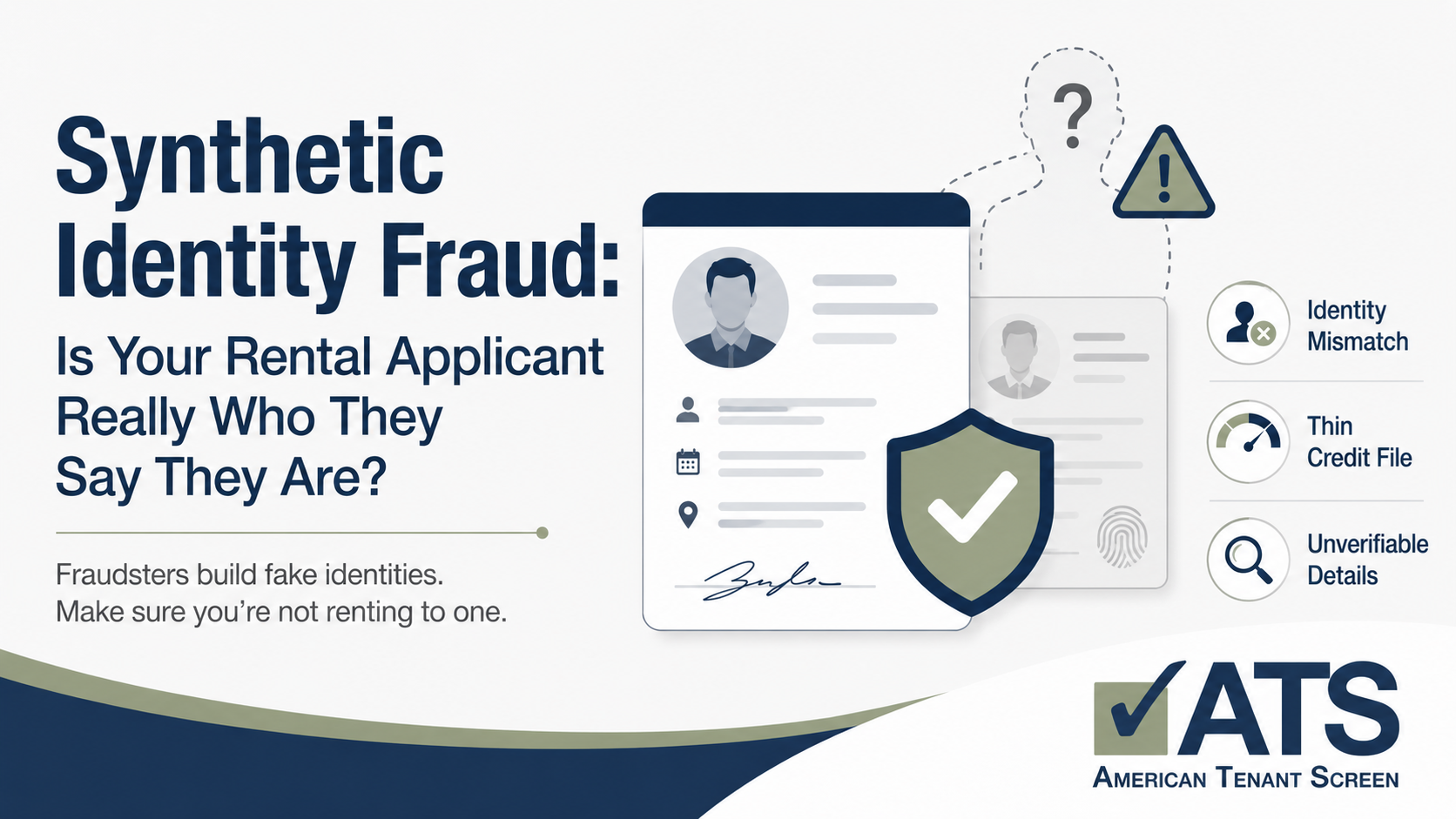
Most property managers are familiar with identity theft.
Someone steals another person's personal information and uses it to open accounts, make purchases, or apply for housing.
Synthetic identity fraud is different.
Instead of using one real person's complete identity, a fraudster may combine pieces of real and fabricated information to create an entirely new identity.
For example, a synthetic identity could include a legitimate Social Security number paired with a different name, address, phone number, or date of birth.
The result can be an applicant who appears legitimate on the surface but whose identity is much harder to verify.
For housing providers, that creates an important question:
Are you screening the person who is actually applying, or are you screening an identity that was created to pass the application process?
What Is a Synthetic Identity?
A synthetic identity is typically built by combining real and false identifying information.
That may include:
- A real Social Security number
- A fabricated or altered name
- A false date of birth
- A newly created email address
- A temporary phone number
- An address that does not align with prior history
- Credit information developed over time under the synthetic identity
Unlike traditional identity theft, synthetic identities can sometimes be difficult to detect because there may not be one obvious victim reporting that their identity was stolen.
In some cases, the synthetic identity may be used repeatedly and gradually develop a credit profile.
That can make it look increasingly legitimate.
Why Synthetic Identity Fraud Matters in Rental Housing
Housing is a high-value target.
A successful fraudulent application can provide access to a property worth thousands of dollars in monthly rent, deposits, utilities, and potential losses.
If a fraudulent applicant obtains possession of a unit, the housing provider may be left dealing with:
- Unpaid rent
- Property damage
- Fraudulent payment methods
- Eviction expenses
- Legal costs
- Lost leasing time
- Difficulty locating the actual individual responsible
The problem is not simply whether the applicant qualifies financially.
It is whether the identity itself can be trusted.
Why Traditional Screening May Not Always Catch It
A typical tenant screening process may evaluate information such as:
- Credit history
- Criminal records
- Eviction history
- Income
- Rental references
But all of those searches depend on one critical assumption:
The applicant's identifying information is accurate.
If the identity itself is false or partially fabricated, screening results may be incomplete, misleading, or attached to someone else.
That is why identity verification should be considered a foundational part of the screening process rather than an afterthought.
Red Flag #1: Identity Information Doesn't Line Up
One of the first warning signs may be inconsistencies between the information provided on the application and information returned during verification.
Examples might include:
- A name that does not match other records
- A date of birth that conflicts with available information
- An address history that appears unusually limited
- A Social Security number that does not align with the applicant's other identifying information
- Multiple pieces of contact information created very recently
Any one discrepancy may have an innocent explanation.
But multiple inconsistencies deserve closer attention.
Red Flag #2: A Very Thin or Unusual Credit Profile
A limited credit file is not automatically suspicious.
Young adults, recent immigrants, people who prefer cash, and applicants who have avoided traditional credit may all have legitimate thin credit histories.
However, a thin file combined with other inconsistencies may be worth reviewing.
For example, you may want to take a closer look if:
- Credit accounts appear unusually recent
- There is little address history
- Contact information changes frequently
- The applicant's stated background does not align with the available history
The goal is not to penalize someone for having limited credit.
It is to determine whether the overall identity information makes sense.
Red Flag #3: Multiple Applicants Share the Same Contact Information
Another potential warning sign is repeated use of the same:
- Phone number
- Email address
- Mailing address
- Employer contact
- Reference contact
across supposedly unrelated applicants.
This could have a legitimate explanation.
Families, roommates, shared housing arrangements, or applicants working with the same relocation professional may use overlapping information.
But repeated patterns can also point to organized fraud.
Red Flag #4: The Applicant Avoids Identity Verification
Fraudsters may try to avoid steps that make verification more difficult.
For example, an applicant may:
- Resist providing required identification
- Submit blurry or incomplete identification
- Provide documents that cannot be validated
- Frequently change identifying information
- Pressure staff to bypass normal procedures
Again, there may be legitimate reasons for some of these situations.
The important point is to follow the same established procedures for every applicant.
Red Flag #5: The Application Looks Complete, But Nothing Can Be Independently Confirmed
A sophisticated fraudulent application may contain all the expected pieces:
- Identification
- Pay stubs
- Employment information
- References
- Bank statements
The challenge is that those pieces may all have been created to support one another.
That is why independent verification is so important.
If every element of the application depends on another piece of information supplied by the applicant, you may not actually be verifying anything.
Identity Verification Should Come Early
Some property managers treat identity verification as the final step.
It often makes more sense to confirm identity before relying heavily on the rest of the screening data.
Think about it this way:
A criminal background report is only useful if it belongs to the applicant.
A credit report is only useful if it belongs to the applicant.
An eviction record is only useful if it belongs to the applicant.
Income documents are only useful if they are tied to the correct person.
Identity is the foundation that connects all of those pieces.
Stronger Verification Does Not Mean More Friction
There is an understandable concern that additional verification can make the application process more difficult.
It does not have to.
Modern verification processes can often be incorporated into the application workflow without creating major delays for legitimate applicants.
The goal should be to make the process:
- Consistent
- Easy to understand
- Secure
- Objective
- Appropriate for the risk involved
Applicants should know upfront what information is required and why.
Avoid Making Fraud Decisions Based on Instinct
One of the risks of increased fraud awareness is that leasing staff may begin relying too heavily on subjective suspicion.
Statements like:
“This applicant just doesn't feel right.”
or
“This document looks strange.”
are not strong screening policies.
A better approach is to establish objective procedures.
For example:
- Verify identity for every applicant
- Require the same types of documentation
- Use consistent methods for resolving discrepancies
- Document the reasons for requesting additional verification
- Apply the same rental criteria across applicants
Standardization helps reduce both fraud risk and inconsistent treatment.
The Growing Importance of Identity Verification
As fraud tools become more sophisticated, identity verification is likely to become even more important.
A screening process that focuses only on credit or criminal history may miss the bigger question:
Do we know who this person actually is?
That doesn't mean every discrepancy is fraud.
It means identity should be verified with the same care as income, employment, and rental history.
The Bottom Line
Synthetic identity fraud creates a unique challenge because the applicant may appear real in several different systems.
There may be a credit file.
There may be employment documents.
There may be references.
There may even be a history associated with the identity.
The challenge is determining whether those pieces belong to a real person and accurately represent the individual applying for your property.
Key Takeaway
Before evaluating whether an applicant qualifies, first make sure you have confidence in one basic fact:
The person being screened is the person actually applying.
A consistent identity verification process can help property managers reduce fraud risk while creating a more reliable foundation for the rest of the screening process.
This article is provided for general informational purposes and is not intended as legal advice. Housing providers should develop screening and identity-verification policies in compliance with applicable federal, state, and local requirements.
Lauren Walton
Director of Client Solutions
I have worked for ATS since 2010, and I am passionate about helping our clients utilize our services to their advantage to find the most qualified tenants and employees. I have a degree in Interior Design, and in my free time, I enjoy cooking, reading, visiting the beach, and spending time with my husband and our dog, Dixie.
Comments (0)
Be the first to comment.