
What Does a Comprehensive Tenant Screening Report Actually Include?
 Lauren Walton·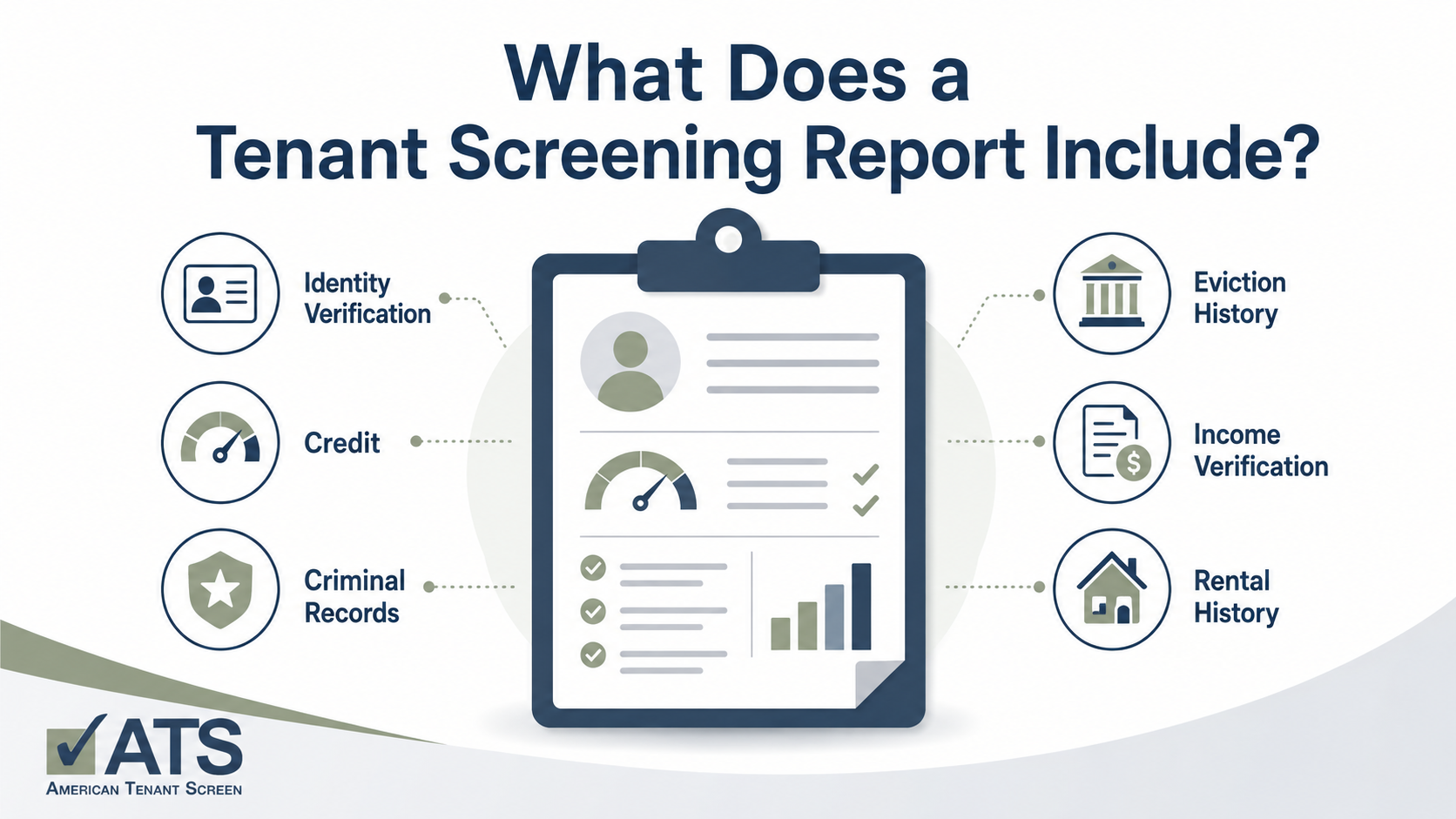
Tenant screening reports can vary significantly from one provider to another.
Some may include only a credit report. Others may combine credit information with criminal records, eviction history, identity verification, rental history, and other data.
For property managers, that can make it difficult to know exactly what they are getting when they order a “tenant screening report.”
And that matters.
A screening report is only as useful as the information it contains, the quality of the data behind it, and the way that information fits into your written rental criteria.
So what should a comprehensive tenant screening report actually include?
Here are some of the most common components.
1. Identity Verification
Before evaluating an applicant's background, you first need confidence that the information belongs to the correct person.
Identity verification may help confirm key identifying information supplied by the applicant, such as:
- Name
- Date of birth
- Social Security number
- Current or previous addresses
- Other identifying information
This step has become increasingly important as rental application fraud and identity manipulation have become more sophisticated.
The goal is simple:
Make sure the person being screened is actually the person applying.
Without reliable identity information, even an otherwise thorough background report can become less useful.
2. Credit Information
Credit information is one of the most familiar components of tenant screening.
Depending on the service and your screening criteria, a report may include information such as:
- Credit score
- Payment history
- Outstanding debt
- Collections
- Accounts in good standing
- Delinquencies
- Bankruptcies
- Overall credit utilization
But property managers should be careful not to treat a single credit score as the entire story.
Two applicants with similar scores may have very different credit histories.
For example, one may have several recent collections while another has a limited credit history but otherwise pays obligations consistently.
That is why many housing providers look at the underlying credit information rather than relying only on a number.
3. Criminal Record Search
Criminal background information can also be part of a tenant screening report.
Depending on the search, this may include records from:
- County courts
- State repositories
- Federal courts
- Other applicable criminal-record sources
The scope and availability of information can vary significantly.
It is also important for housing providers to understand that criminal records should not automatically be treated as a simple “pass” or “fail.”
Policies should be developed carefully and applied consistently, with attention to applicable Fair Housing requirements and federal, state, and local laws.
The age of the record, nature of the offense, disposition, and relevance to legitimate housing interests may all matter depending on the circumstances and applicable requirements.
4. Eviction History
Eviction-related records are another common screening component.
These records may help housing providers identify past landlord-tenant court cases or eviction filings.
However, an eviction record requires context.
An eviction filing does not always mean a tenant was ultimately evicted.
Cases may have been:
- Dismissed
- Settled
- Resolved in favor of the tenant
- Filed against the wrong person
- Connected to circumstances that require further review
That is why accuracy and proper interpretation are essential.
A screening process should distinguish between a record existing and what that record actually says.
5. Rental History
Rental history can provide another perspective on how an applicant has handled previous housing obligations.
Depending on your process, rental history verification may include questions such as:
- Did the applicant live at the address provided?
- Were rental payments made as agreed?
- Was proper notice given before moving?
- Was there a documented outstanding balance?
- Were lease terms followed?
- Is the applicant eligible for re-rental?
Landlord references can be helpful, but they should be handled consistently.
Property managers should also be cautious about relying solely on phone numbers provided by the applicant without determining whether the reference can be independently verified.
6. Income and Employment Verification
A screening process may also include income or employment verification.
This can be particularly important because the ability to meet rental obligations is usually a key part of rental qualification criteria.
Verification methods may vary depending on the applicant.
Traditional employees might provide employment or payroll information, while self-employed applicants, independent contractors, retirees, or applicants with other legitimate income sources may require different documentation.
A strong policy clearly establishes what documentation is acceptable and applies those standards consistently.
The key is not simply collecting paperwork.
It is determining whether the information being relied upon can be reasonably verified.
7. Address History
Address history can help connect identifying information with previous residences.
It may also help identify inconsistencies between:
- The addresses listed on an application
- Information appearing in public records
- Credit-related information
- Previous rental references
An address discrepancy does not automatically indicate fraud.
People move, records can be outdated, and legitimate variations occur frequently.
But multiple unexplained inconsistencies may justify additional verification under your established procedures.
8. Public Record Information
Depending on the report and applicable laws, tenant screening may include certain public-record information.
The exact information available can vary by jurisdiction and provider.
This is an area where data quality matters considerably.
Property managers should understand:
- Where the information comes from
- How frequently it is updated
- How identities are matched to records
- What procedures exist for handling disputes or inaccuracies
A large volume of data is not necessarily the same as high-quality data.
What Isn't Included Can Matter Just as Much
One of the most important questions property managers can ask is:
What does this report not include?
The phrase “background check” can mean many different things.
A report described as comprehensive may still exclude certain searches, jurisdictions, verification services, or data sources.
Before choosing a screening provider, ask exactly which searches are included and whether additional searches may be appropriate based on your properties and written screening criteria.
National Database Searches Shouldn't Be Confused With Every Possible Record
A common misconception is that one database contains every criminal or court record in the country.
It does not.
Different courts, counties, states, and record systems maintain information differently.
That is why screening providers may use multiple sources and search strategies.
Understanding the scope of a search can help property managers better understand the results they receive.
Accuracy Matters More Than Volume
A screening report containing hundreds of data points isn't automatically better than one containing fewer, more reliable records.
What matters is whether the information is:
- Accurate
- Current where required
- Properly matched to the applicant
- Legally reportable
- Relevant to your established screening criteria
False positives and mismatched records can create serious problems for both applicants and housing providers.
Quality screening is not simply about finding more information.
It is about finding the right information about the right person.
A Screening Report Is a Tool, Not the Decision
One of the most important things to remember is that a tenant screening report does not make the rental decision.
The housing provider does.
The report provides information that can be evaluated against established rental criteria.
That distinction is important.
Rather than making decisions based on instinct or treating every record as automatically disqualifying, property managers should have written screening standards and apply them consistently.
Questions to Ask About Your Current Screening Report
If you haven't reviewed your screening process recently, consider asking:
- Which searches are included?
- Where does the information come from?
- How is applicant identity verified?
- How are possible record matches confirmed?
- How often are data sources updated?
- What happens if an applicant disputes information?
- Are there additional searches available when necessary?
- Does our process align with our written rental criteria?
If you cannot easily answer those questions, it may be time to take a closer look at your screening process.
The Bottom Line
A comprehensive tenant screening report is more than a credit score or a quick database search.
Depending on your policies, it may bring together identity information, credit history, criminal records, eviction information, rental history, income verification, and other relevant data.
But the number of searches is only part of the equation.
The quality of the data, the accuracy of the matching process, and the consistency of your decision-making procedures matter just as much.
Key Takeaway
When evaluating tenant screening services, don't simply ask:
“Do you offer background checks?”
Ask:
“Exactly what information are we receiving, where does it come from, and how does it help us make a consistent rental decision?”
Understanding what is—and isn't—in your tenant screening report can help you build a stronger and more reliable screening process.
This article is provided for general informational purposes and is not intended as legal advice. Tenant screening requirements vary by jurisdiction. Housing providers should consult qualified counsel regarding applicable federal, state, and local requirements.
Lauren Walton
Director of Client Solutions
I have worked for ATS since 2010, and I am passionate about helping our clients utilize our services to their advantage to find the most qualified tenants and employees. I have a degree in Interior Design, and in my free time, I enjoy cooking, reading, visiting the beach, and spending time with my husband and our dog, Dixie.
Comments (0)
Be the first to comment.